Use this discussion guide from the Ohio BWC to talk to your staff on how to prevent slips, trips, & falls at your facility.
What is Podcasting?
As many of you know, we recently have launched the Portage County Safety Council Podcast. We realize that some of our members may not be familiar with podcasting so we thought it would be fun to write a quick blog to link those members to some great podcasting info.
Don’t worry! If you already know what a podcast is, we included some pretty cool stats that you may enjoy (see graphic below).
- What is a podcast? “A digital audio or video file or recording, usually part of a themed series, that can be downloaded from a website to a media player or computer.” – Dictionary.com
- Where did the term come from? “The word originated as a portmanteau of ‘iPod’ (a brand of media player) and ‘broadcast’.” – Wikipedia
- How many people listen to podcasts? “112 million Americans have listened to a podcast” and “42 million Americans listen to podcasts weekly, five times more than go to the movies.” – Source
- Do people actually listen to entire episodes? “86% listen to all or most of each episode”. – PodcastInsights.com
Courtesy of Podcast Insights.com.

Dec 21, 2017 – Ohio Public Employment Risk Reduction Program (PERRP) Update
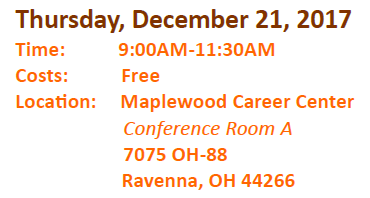
Description: Do you know the difference between OSHA and PERRP? Did you know that the Ohio Revised Code statutes recently changed that govern PERRP operations? This seminar will help you understand the differences between the two agencies and provide an overview of the recent statute changes. Attend this seminar and learn how the changes will impact Ohio public employers. Next spring a new public employer safety and health recognition program will roll out across Ohio. Is your workplace ready to meet the challenge and participate in this unique program?
Seminar Learning Objectives:
- Be familiar with PERRP workplace inspection priorities and recognize the most common hazards identified during on-site visits.
- Understand the PERRP complaint process and the most common complaint issues.
- Learn about PERRP specialized compliance assistance safety and health services for Ohio’s state, county and local government agencies, school districts, public colleges and universities.
- Discover how you can use PERRP compliance assistance services to improve the safety of your workplace and prevent injuries and illnesses.
- Return to your workplace with tools you can use to raise awareness of occupational safety & health hazards and risk factors.
December 2017 Safety Update
Brought to you by the Ohio BWC Library…
Dec 14, 2017 – Effective Safety Teams
This training event is hosted by the North Canton Service Office of the Ohio BWC. It is not a PCSC event but does qualify for 1 external training credit.
Jan 18, 2017 – Reducing lower-back injuries with a privacy-aware compliance tracking system
“Reducing lower-back injuries with a privacy-aware compliance tracking system,” presented by Dr. Wenbing Zhao, Professor, Department of Electrical Engineering and Computer Science at Cleveland State University.
Hosted by the American Society of Safety Engineers Northern Ohio Chapter. Please note: this is not a PCSC sponsored event.
Date: Thursday, January 18, 2018
Time: 5:30pm
Location: Creekside Restaurant, 8803 Brecksville Rd, Brecksville, OH 44141.
Carbon Monoxide: December 2017 Safety & Hygiene Corner
Question:
The cold season is around the corner—should we be concerned with carbon monoxide?
Answer:
Carbon monoxide (CO) is a colorless, odorless, toxic gas which interferes with the oxygen-carrying capacity of blood. CO is non-irritating and can overcome persons without warning. Many people die from CO poisoning, usually while using gasoline powered tools and generators in buildings or semi-enclosed spaces without adequate ventilation.
Effects of Carbon Monoxide Poisoning
- Severe carbon monoxide poisoning causes neurological damage, illness, coma and death.
Symptoms of CO exposure
- Headaches, dizziness and drowsiness.
- Nausea, vomiting, tightness across the chest.
Some Sources of Exposure
- Portable generators/generators in buildings.
- Concrete cutting saws, compressors.
- Power trowels, floor buffers, space heaters.
- Welding, gasoline powered pumps.
Preventing CO Exposure
- Never use a generator indoors or in enclosed or partially enclosed spaces such as garages, crawl spaces, and basements. Opening windows and doors in an enclosed space may prevent CO buildup.
- Make sure the generator has 3-4 feet of clear space on all sides and above it to ensure adequate ventilation.
- Do not use a generator outdoors if placed near doors, windows or vents which could allow CO to enter and build up in occupied spaces.
- When using space heaters and stoves ensure that they are in good working order to reduce CO buildup, and never use in enclosed spaces or indoors.
- Consider using tools powered by electricity or compressed air, if available.
- If you experience symptoms of CO poisoning get to fresh air right away and seek immediate medical attention.
U.S. Department of Labor
http://www.osha.gov (800) 321-OSHA
Brought to you by Ohio BWC safety consultants.
Dec. 6, 2017 – Safety for the Non-Safety Professional
This training event is hosted by the North Canton Service Office of the Ohio BWC. It is not a PCSC event but does qualify for 1 external training credit.
Walking-Working Surfaces: November 2017 Safety & Hygiene Corner
Question:
Do I need to inspect the walking -working surfaces in my facility?
Answer:
Yes, according to OSHA’s revised walking-working surfaces rule. OSHA’s definition of a walking-working surface is any horizontal or vertical surface on or through which an employee walks, works, or gains access to a work area or workplace location. The employer must inspect the surfaces, regularly and as necessary, to ensure they are maintained in a safe condition. If a hazardous condition is recognized, the condition is to be corrected or repaired before an employee uses the surface again. If the correction or repair cannot be made immediately, the hazard must be guarded to prevent employees from using the surface. Hazardous conditions may include sharp or protruding objects, loose boards, corrosion, leaks, spills, snow, and ice. For more information on the revised rule, see Subpart D of 29 CFR 1910.
Brought to you by Ohio BWC safety consultants.
Fall Protection Competent Person Training – March 27-28, 2018
Date: Tuesday, March 27, and Wednesday, March 28, 2018
Time: 8:00am-5:00pm
Location: Maplewood Career Center, 7075 St Rt 88, Ravenna, OH 44266
Price: $245 for up-to-date PCSC members (seating is limited to 10 people total)
Registration Deadline: December 31, 2017 (payment required at registration and based on first come/first served)
Click here for the registration form.

 Portage County Safety Council
You must be logged in to post a comment.