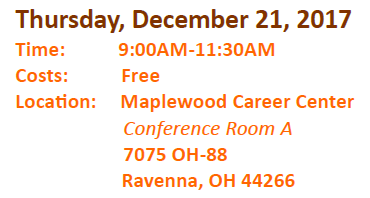
Dec 21, 2017 – Ohio Public Employment Risk Reduction Program (PERRP) Update

Date Snip

Click here to register.

Click here for the flyer.

Description: Do you know the difference between OSHA and PERRP? Did you know that the Ohio Revised Code statutes recently changed that govern PERRP operations? This seminar will help you understand the differences between the two agencies and provide an overview of the recent statute changes. Attend this seminar and learn how the changes will impact Ohio public employers. Next spring a new public employer safety and health recognition program will roll out across Ohio. Is your workplace ready to meet the challenge and participate in this unique program?

Seminar Learning Objectives:

  1. Be familiar with PERRP workplace inspection priorities and recognize the most common hazards identified during on-site visits.
  2. Understand the PERRP complaint process and the most common complaint issues.
  3. Learn about PERRP specialized compliance assistance safety and health services for Ohio’s state, county and local government agencies, school districts, public colleges and universities.
  4. Discover how you can use PERRP compliance assistance services to improve the safety of your workplace and prevent injuries and illnesses.
  5. Return to your workplace with tools you can use to raise awareness of occupational safety & health hazards and risk factors.

Jan 18, 2017 – Reducing lower-back injuries with a privacy-aware compliance tracking system

“Reducing lower-back injuries with a privacy-aware compliance tracking system,” presented by Dr. Wenbing Zhao, Professor, Department of Electrical Engineering and Computer Science at Cleveland State University.

Hosted by the American Society of Safety Engineers Northern Ohio Chapter. Please note: this is not a PCSC sponsored event.

Date: Thursday, January 18, 2018
Time: 5:30pm
Location: Creekside Restaurant, 8803 Brecksville Rd, Brecksville, OH 44141.

Click here for the flyer and more information.

Carbon Monoxide: December 2017 Safety & Hygiene Corner

Question:

The cold season is around the corner—should we be concerned with carbon monoxide?

Answer:

Carbon monoxide (CO) is a colorless, odorless, toxic gas which interferes with the oxygen-carrying capacity of blood. CO is non-irritating and can overcome persons without warning. Many people die from CO poisoning, usually while using gasoline powered tools and generators in buildings or semi-enclosed spaces without adequate ventilation.

Effects of Carbon Monoxide Poisoning

  • Severe carbon monoxide poisoning causes neurological damage, illness, coma and death.

Symptoms of CO exposure

  • Headaches, dizziness and drowsiness.
  • Nausea, vomiting, tightness across the chest.

Some Sources of Exposure

  • Portable generators/generators in buildings.
  • Concrete cutting saws, compressors.
  • Power trowels, floor buffers, space heaters.
  • Welding, gasoline powered pumps.

Preventing CO Exposure

  • Never use a generator indoors or in enclosed or partially enclosed spaces such as garages, crawl spaces, and basements. Opening windows and doors in an enclosed space may prevent CO buildup.
  • Make sure the generator has 3-4 feet of clear space on all sides and above it to ensure adequate ventilation.
  • Do not use a generator outdoors if placed near doors, windows or vents which could allow CO to enter and build up in occupied spaces.
  • When using space heaters and stoves ensure that they are in good working order to reduce CO buildup, and never use in enclosed spaces or indoors.
  • Consider using tools powered by electricity or compressed air, if available.
  • If you experience symptoms of CO poisoning get to fresh air right away and seek immediate medical attention.

U.S. Department of Labor

http://www.osha.gov (800) 321-OSHA

Brought to you by Ohio BWC safety consultants.

Walking-Working Surfaces: November 2017 Safety & Hygiene Corner

Question:

Do I need to inspect the walking -working surfaces in my facility?

Answer:

Yes, according to OSHA’s revised walking-working surfaces rule. OSHA’s definition of a walking-working surface is any horizontal or vertical surface on or through which an employee walks, works, or gains access to a work area or workplace location. The employer must inspect the surfaces, regularly and as necessary, to ensure they are maintained in a safe condition. If a hazardous condition is recognized, the condition is to be corrected or repaired before an employee uses the surface again. If the correction or repair cannot be made immediately, the hazard must be guarded to prevent employees from using the surface. Hazardous conditions may include sharp or protruding objects, loose boards, corrosion, leaks, spills, snow, and ice. For more information on the revised rule, see Subpart D of 29 CFR 1910.

Brought to you by Ohio BWC safety consultants.

October 12, 2017 – Fire Safety For Your Business

Greetings Safety Council Members!

Our next meeting is Thursday, October 12, 2017, 11:30am-1:00pm, at the Ravenna Elks Club which is located at 776 N Freedom St in Ravenna.  The official meeting notice is attached.

Fire Safety for Your Business, presented by Capt. Lynn of the Kent Fire Department.

This training is ideal for safety managers and all staff!

Please RSVP no later than 12pm on Monday, October 9, 2017.

CLICK HERE TO RSVP NOW

Please make your check payable to: “Portage County Safety Council.” If you would like to pay by credit card prior to the event, please email us for an invoice. Cost for lunch is still just $15/person for members and $20 for non-members.

OSHA Violence Requirements: October 2017 Safety & Hygiene Corner

Question:

What does OSHA require regarding violence in the workplace and active shooter programs and training?

Answer:

OSHA does not have a specific standard on violence in the workplace or active shooter/ active aggressor situations.  However, under the General Duty Clause, Section 5(a)(1) of the Occupational Safety and Health Act (OSHA) of 1970, employers are required to provide their employees with a place of employment that “is free from recognizable hazards that are causing or likely to cause death or serious harm to employees.” An employer that has experienced acts of workplace violence, or becomes aware of threats, intimidation, or other indicators showing that the potential for violence in the workplace exists, would be on notice of the risk of workplace violence and should implement a workplace violence prevention program combined with engineering controls, administrative controls, and training.

There are many options to start on this journey.  The BWC has a half day violence in the workplace class and your BWC consultant or local law enforcement can help you create a policy.  Training can be done in-house, online or with your local law enforcement.  There are many companies that focus on security and violence in the workplace if you are interested in seeking other outside help.  Two well known training programs dealing with active shooters are:  The Department of Homeland Security’s: Run, Hide, Fight and the ALiCE method offered by the ALiCE training institute.

Brought to you by Ohio BWC safety consultants.