January 2018 Newsletter

Welcome to the 2nd edition of our new monthly newsletter!

Our goal for the newsletter is to connect our members to relevant safety resources, all linked together in one convenient location every month. We hope you find this resource useful and valuable!

SAFETY RESOURCES:

  1. Podcast Safety Talks: Rig it Right: Interview with Al Abel (24:16), Winter Driving Safety (7:18) & Winter Vehicle Prep (3:15) with AAA, and more!
  2. January’s Safety Update from the Ohio BWC Library.
  3. BWC Updates: These are the power points presented by BWC Representative Nic Coia at our monthly meetings, including the most recent one from 1/11/18.
  4. Facial Hair & Respirators: January Safety & Hygiene Corner. Provided by BWC staff.
  5. Active Shooter Planning: 9 Things You Must Include in Your Emergency Action Plan. A blog by Tim Dimoff of SACS Consulting.

PCSC NEWS:

Facial Hair & Respirators: January 2018 Safety & Hygiene Corner

Question:

So, you want to grow out your beard, but wear a tight-fitting respirator at work?

Answer:

Ensuring the respirator seal is a vital part of respiratory protection practices. Facial hair that lies along the sealing area of a respirator, such as beards, sideburns, or some mustaches, will interfere with respirators that rely on a tight face piece seal to achieve maximum protection. Facial hair is a common reason that someone cannot be fit tested.

The reason for this is simple – gases, vapors, and particles in the air will take the path of least resistance and bypass the part of the respirator that captures or filters hazards out. So then, why can’t facial hair act as a crude filter to capture particles that pass between the respirator sealing area and the skin?  While human hair appears to be very thin to the naked eye, hair is much larger in size than the particles inhaled. Facial hair is just not dense enough and the individual hairs are too large to capture particles like an air filter does; nor will a beard trap gases and vapors like the carbon bed in a respirator cartridge.  Therefore, the vast majority of particles, gases, and vapors follow the air stream right through the facial hair and into respiratory tract of the wearer. In fact, some studies have shown that even a day or two of stubble can begin to reduce protection. Research tells us that the presence of facial hair under the sealing surface causes 20 to 1000 times more leakage compared to clean-shaven individuals.

The Respiratory Protection standard, paragraph 29 CFR 1910.134(g)(1)(i)(A), states that respirators shall not be worn when facial hair comes between the sealing surface of the facepiece and the face or that interferes with valve function. Facial hair is allowed as long as it does not protrude under the respirator seal, or extend far enough to interfere with the device’s valve function. Short mustaches, sideburns, and small goatees that are neatly trimmed so that no hair compromises the seal of the respirator usually do not present a hazard and, therefore, do not violate paragraph 1910.134(g)(1)(i).

Provided by Ohio BWC staff.

What is Podcasting?

As many of you know, we recently have launched the Portage County Safety Council Podcast. We realize that some of our members may not be familiar with podcasting so we thought it would be fun to write a quick blog to link those members to some great podcasting info.

Don’t worry! If you already know what a podcast is, we included some pretty cool stats that you may enjoy (see graphic below).

  1. What is a podcast?A digital audio or video file or recording, usually part of a themed series, that can be downloaded from a website to a media player or computer.” – Dictionary.com
  2. Where did the term come from? “The word originated as a portmanteau of ‘iPod’ (a brand of media player) and ‘broadcast’.” – Wikipedia
  3. How many people listen to podcasts? “112 million Americans have listened to a podcast” and “42 million Americans listen to podcasts weekly, five times more than go to the movies.” – Source
  4. Do people actually listen to entire episodes? “86% listen to all or most of each episode”. – PodcastInsights.com

Courtesy of Podcast Insights.com.

2017 Podcast Statistics


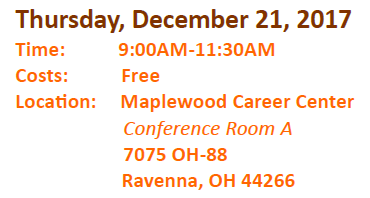
Dec 21, 2017 – Ohio Public Employment Risk Reduction Program (PERRP) Update

Date Snip

Click here to register.

Click here for the flyer.

Description: Do you know the difference between OSHA and PERRP? Did you know that the Ohio Revised Code statutes recently changed that govern PERRP operations? This seminar will help you understand the differences between the two agencies and provide an overview of the recent statute changes. Attend this seminar and learn how the changes will impact Ohio public employers. Next spring a new public employer safety and health recognition program will roll out across Ohio. Is your workplace ready to meet the challenge and participate in this unique program?

Seminar Learning Objectives:

  1. Be familiar with PERRP workplace inspection priorities and recognize the most common hazards identified during on-site visits.
  2. Understand the PERRP complaint process and the most common complaint issues.
  3. Learn about PERRP specialized compliance assistance safety and health services for Ohio’s state, county and local government agencies, school districts, public colleges and universities.
  4. Discover how you can use PERRP compliance assistance services to improve the safety of your workplace and prevent injuries and illnesses.
  5. Return to your workplace with tools you can use to raise awareness of occupational safety & health hazards and risk factors.

Walking-Working Surfaces: November 2017 Safety & Hygiene Corner

Question:

Do I need to inspect the walking -working surfaces in my facility?

Answer:

Yes, according to OSHA’s revised walking-working surfaces rule. OSHA’s definition of a walking-working surface is any horizontal or vertical surface on or through which an employee walks, works, or gains access to a work area or workplace location. The employer must inspect the surfaces, regularly and as necessary, to ensure they are maintained in a safe condition. If a hazardous condition is recognized, the condition is to be corrected or repaired before an employee uses the surface again. If the correction or repair cannot be made immediately, the hazard must be guarded to prevent employees from using the surface. Hazardous conditions may include sharp or protruding objects, loose boards, corrosion, leaks, spills, snow, and ice. For more information on the revised rule, see Subpart D of 29 CFR 1910.

Brought to you by Ohio BWC safety consultants.

October 12, 2017 – Fire Safety For Your Business

Greetings Safety Council Members!

Our next meeting is Thursday, October 12, 2017, 11:30am-1:00pm, at the Ravenna Elks Club which is located at 776 N Freedom St in Ravenna.  The official meeting notice is attached.

Fire Safety for Your Business, presented by Capt. Lynn of the Kent Fire Department.

This training is ideal for safety managers and all staff!

Please RSVP no later than 12pm on Monday, October 9, 2017.

CLICK HERE TO RSVP NOW

Please make your check payable to: “Portage County Safety Council.” If you would like to pay by credit card prior to the event, please email us for an invoice. Cost for lunch is still just $15/person for members and $20 for non-members.